Discover the Upper Black Forest — Region for your Black Forest Dream vacation
The Upper Black Forest lies entirely within Baden-Württemberg, in the Breisgau-Hochschwarzwald district, around the Feldberg (1,493 m) — Germany's highest point outside the Alps. Its subalpine climate brings over 1,800 mm of rain a year and snow-sure winters. Tourism dates to the 1890s, extending into summer once the Höllentalbahn opened in 1887 — Feldberg remains the base for day trips.
At a glance
- Highest point
- Feldberg (1,493 m)
- Location
- Baden-Württemberg, Breisgau-Hochschwarzwald district
- Lakes
- Titisee, Schluchsee
- Climate
- subalpine, over 1,800 mm rain/year
- Tourism since
- 1890s (winter), 1887 Höllentalbahn (summer)
- Central base
- Feldberg
The Upper Black Forest (German: Hochschwarzwald) is the highest region of the Black Forest in southern Germany. Here lie Feldberg, Titisee and Schluchsee — and some of the most well-known hiking and winter sports areas in Germany.
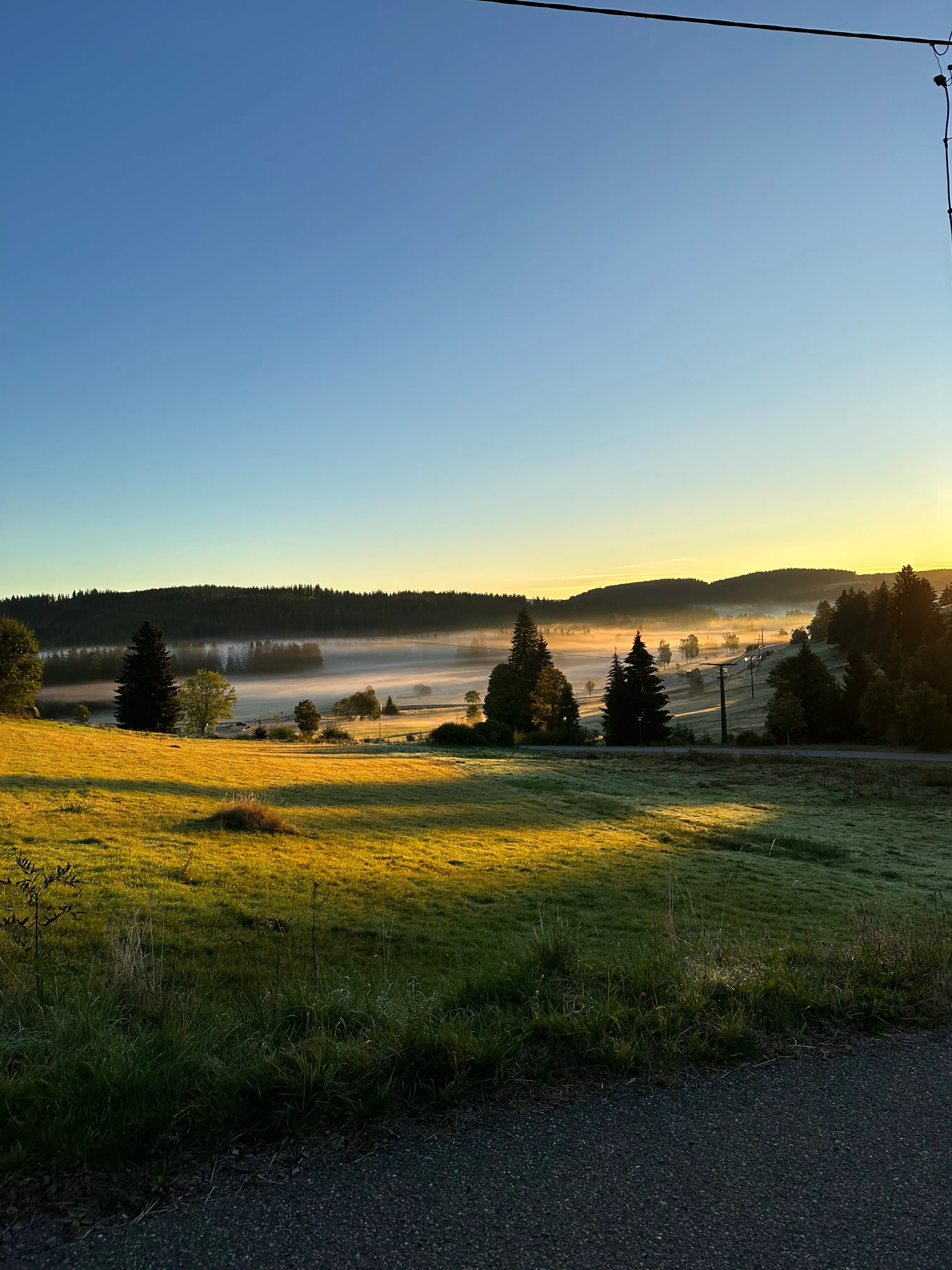
What is the Upper Black Forest?
The Upper Black Forest (in German "Hochschwarzwald") is the southernmost and highest sub-region of the Black Forest. It stretches roughly between the Belchen in the west, the Feldberg in the centre and the Schluchsee in the east. The region lies entirely within the federal state of Baden-Württemberg, in the Breisgau-Hochschwarzwald district.
Characteristic are elevations above 1,000 metres, extensive fir and spruce forests, high moors, glacial cirque lakes and gentle high meadows ("Almen"). In contrast to the northern and central Black Forest, the Upper Black Forest has a subalpine character — with longer winters, more reliable snow and a vegetation period shorter than in the valleys.
The main mountains
- Feldberg (1,493 m) — highest mountain of the Black Forest and the highest elevation in Germany outside the Alps. Largest ski area in the region (Liftverbund Feldberg) and a nature reserve since 1937.
- Herzogenhorn (1,415 m) — second-highest peak, popular with hikers and cross-country skiers. Offers one of the best panoramas over the Upper Black Forest.
- Belchen (1,414 m) — westernmost main peak with cable car and mountain inn. The view extends in foehn weather to the Swiss Alps and Mont Blanc.
- Schauinsland (1,284 m) — Freiburg's local mountain, with the Schauinslandbahn (Germany's longest gondola circuit).
- Hinterwaldkopf (1,198 m) — less well-known, but rewarding for quiet hikes off the main routes.
The main lakes
- Titisee (846 m, 1.3 km²) — best-known lake in the Black Forest. A glacial lake from the last ice age. Tourism hub with Seestrasse, boat hire and Badeparadies Schwarzwald.
- Schluchsee (930 m, 5.1 km²) — largest lake in the Black Forest (reservoir). Popular for swimming, SUP, sailing and the 18 km lakeside hike.
- Feldsee (1,109 m, 0.1 km²) — small glacial cirque lake at the foot of the Feldberg. Within the nature reserve, swimming forbidden, but spectacular to see.
- Windgfällweiher (910 m) — small quiet lake between Feldberg and Schluchsee. An insider tip for relaxed walks.
The main towns
- Feldberg (municipality, approx. 1,900 inhabitants) — Germany's highest-elevation municipality. Includes the districts Altglashütten, Bärental, Falkau and Feldberg-Ort.
- Titisee-Neustadt (approx. 12,000 inhabitants) — largest town in the region. Tourist centre with railway station and many hotels.
- Hinterzarten (approx. 2,500 inhabitants) — luxurious winter sports town with ski jumping hill and ski museum.
- Schluchsee (approx. 2,300 inhabitants) — the namesake town on the eponymous lake.
- Lenzkirch (approx. 4,700 inhabitants) — historic clockmaking town, today a popular holiday and hiking location.
- Todtnau (approx. 4,500 inhabitants) — winter sports centre with the Hasenhorn Coaster and the Todtnau waterfall (97 m high, one of Germany's tallest natural waterfalls).
Climate
The Upper Black Forest has a subalpine to alpine climate. Precipitation at over 1,800 mm per year is significantly above the German average. Winters are cold and snowy (snow depths on Feldberg regularly 1-2 metres), summers pleasantly cool (peak temperatures at the Feldberg summit rarely above 25 °C).
The vegetation period is only about 130-150 days per year — accordingly, the flora is adapted to elevation, with species such as alpenrose, martagon lily and arnica.
History
The Upper Black Forest was for centuries an area of glassworks (hence the names Altglashütten and Neuglashütten — "old/new glassworks"), charcoal burning and forestry. The glassworks lived from the enormous timber stocks of the forests. In the 19th century the economy shifted to clockmaking, wood processing and increasingly to tourism.
Winter tourism began in the 1890s on the Feldberg, summer tourism with the construction of the Höllentalbahn in 1887. Today tourism is the most important economic factor — with about 8 million overnight stays per year in the region.
See and experience
- • Summer activities at Feldberg — hiking, mountain lakes, climbing, mountain biking
- • Winter activities at Feldberg — skiing, cross-country, snowshoeing
- • The 5 most beautiful hiking trails at Feldberg
- • Titisee and Schluchsee: best day trips
- • Skiing at Feldberg: complete guide
- • Feldberg or Titisee? Comparison
- • 10 family activities at Feldberg
Where to stay
Anyone wanting to experience the Upper Black Forest should stay centrally — Feldberg lies at the geographical centre of the region and is the ideal starting point for day trips to Titisee, Schluchsee, Freiburg and into the Wiesental.
Frequently Asked Questions
How high is the Feldberg?
At 1,493 metres, the Feldberg is the highest mountain in the Black Forest and the highest elevation in Germany outside the Alps.
Which lake is the most famous in the Upper Black Forest?
Titisee is the best-known lake in the Black Forest — a glacial lake from the last ice age with Seestrasse, boat hire and the Badeparadies Schwarzwald.
What is the climate like in the Upper Black Forest?
The Upper Black Forest has a subalpine to alpine climate with over 1,800 mm of precipitation per year, snowy winters (1-2 metres of snow depth on Feldberg) and pleasantly cool summers.
Since when has tourism existed in the Upper Black Forest?
Winter tourism began in the 1890s on the Feldberg, summer tourism with the construction of the Höllentalbahn in 1887 — today the region counts about 8 million overnight stays per year.
Where is the best place to stay for day trips in the region?
Feldberg lies at the geographical centre of the Upper Black Forest and is the ideal starting point for day trips to Titisee, Schluchsee, Freiburg and the Wiesental.
Black Forest Dream at Feldberg
Premium holiday apartments right in the Upper Black Forest — self check-in, mountain panorama, infrared sauna and 7% cheaper than on Booking.com.